Wednesday, 26 August 2009

Lesser Black-backed Gull (Larus fuscus intermedius), 2cy, 8.8.2009, Lakolk Strand, Rømø

All photos illustrate putative Larus fuscus intermedius, but the identification is hard to clinch for certain without knowing which nesting area the bird originate from.


Tuesday, 25 August 2009

Lesser Black-backed Gull (Larus fuscus graellsii), 9cy+, 17.8.2009, Aarhus East Harbor

Fuglen er ringmærket på højre ben og har ikke rigtigt gule ben, hvilket gør fuglen genkendelig. Den er set årligt på lokaliteten siden 2004, hvor den også var adult i dragten. Billeder fra tidligere år kan ses på Århusbirder og eksempelvis her på GullDK. Den ankommer typisk i sensommeren fra august og bliver til sidst på efteråret i november, hvorefter den forsvinder igen. Endnu har det ikke været muligt at aflæse ringen, men måske det skal blive denne sæson?


Lesser Black-backed Gull (Larus fuscus graellsii), 5cy+, 9.11.2005, Aarhus East Harbor

Fuglen er ringmærket på højre ben og har ikke rigtigt gule ben, hvilket gør fuglen genkendelig. Den er set årligt på lokaliteten siden 2004, hvor den også var adult i dragten. Den ankommer typisk i sensommeren fra august og bliver til sidst på efteråret i november, hvorefter den forsvinder igen.


Stormmåge (Larus canus), 2cy, 22.8.2009, Danzigmand, Læsø

This gull stood out in direct comparison to the numerous associating Common Gulls due to its heavy structure and was in a similar body size to an average Ring-billed Gull.


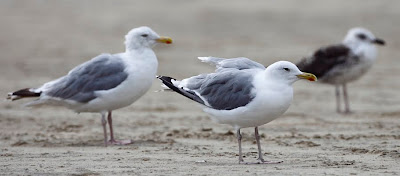
Note that the argentatus has yellow legs


Great Black-backed Gull (Larus marinus), 1cy, 22.8.2009, Østerby Harbor, Læsø

This is an unusually pale marinus in juvenile plumage with the size not much bigger than argentatus and with a rather slim and elongated profile but yet still a marinus.

Great Black-backed Gull (Larus marinus), 1k, 22.8.2009, Østerby Harbor, Læsø.
Next to a juvenile European Herring Gull.
Next to a juvenile European Herring Gull and some normal sized Great Black-backed Gulls.

Monday, 10 August 2009

Yellow-legged Gull (Larus michahellis), ad, 9.8.2009, Vejle Harbor

This Yellow-legged Gull has a typical heavy bill with strong colours, red orbital ring and yellowish iris, warm yellow legs, darker upperparts with more saturated blue grey tone than on argentatus in direct comparison, slender and long-winged appearance with elongated body profile. On the opened wing the five inner most primaries are all of new generation with p5 still growing and with a typical black band, both p6 and p7 are missing and p8, p9 and p10 has not yet been shed luckily allowing us to view the large amount of black on these feathers and the isolated mirror on p9 and p10. On the underwing the classic darker ash grey tone on the primaries is apparent especially on the renewed feathers giving a stronger contrast to the white coverts.


Yellow-legged Gull (Larus michahellis), 3cy, 9.8.2009, Lakolk Strand, Rømø


Caspian Gull (Larus cachinnans), ad, 9.8.2009, Lakolk Strand, Rømø

This Caspian Gull has relative long pale greyish legs. Most often when seeing cachinnans the thinner legs with longer tibia compared to argentatus is quite distinctive (less so in some female-type cachinnans). On the yawning gull the bare part colour in the opened bill is spot on cachinnans being orangey-yellow at the base of the mandibles where the colour is typical blood red in michahellis and light pink in argentatus.

The small eye is relative dark with a classic green peppering in the iris – most easily seen when light hits the eye directly - and when seen at some distance due to the peppering and the smaller size it stood out at being rather dark in contrast to nearby argentatus. There is a thin red orbital ring seen at close range.

It has a good cachinnans jizz with a high push up breast, belly slightly dropped behind legs and long slim rear with the unmoulted p9 and p10 just adding to elongated impression given by this species. Additionally the upperpart are slightly darker than on nearby argentatus .

In the stretched wing the grey tongues on the outer primaries are obvious, on p5 there is a black band, on p10 the outer tip is all white and there is a small white mirror on p9. The white apical spots are all relative small due to wear adding to the all this classic cachinnans wing pattern.


Kaspisk Måge - Larus cachinnans - Caspian Gull