The presentation has been arranged so that the photos of the gull seen on February 4, 2012 in Hvide Sande Harbour in Denmark allow a direct comparison to a wide selection of Thayer’s Gulls. The idée is that the selection of Thayer’s can be used for future reference.
Showing posts with label Larus thayeri. Show all posts
Showing posts with label Larus thayeri. Show all posts
Sunday, 15 September 2013

Sunday, 27 January 2013
Sexual size dimorphism in Thayer's Gull is significant
Last week I spend two days at the Zoological Museum Copenhagen where they have one of the largest tissue collections of birds in the world. While working my way through different topics I came across the large gull species where a male-type Thayer’s Gull immediately attracted my attention - it is the same individual in all the photos. I was struck by its impressive head and bill, but also its apparently large size compared to the argentatus Herring Gulls in the tray next to it. This reminded me of all the people I have heard talking about how they normally consider thayeri to be a relatively small and petit species. I think the literature is to blame for this rift as our current field guides don't give the impression that there is a high degree of dimorphism between sexes in Thayer’s Gull unless you evaluate the measurements.
Another thing that called for attention was the apparent shape of the nostrils. I have looked at this character before without being able to conclude its relative importance when identifying Thayer's Gull, but again I was surprised to see that even though there were not many thayeri in the museum collection, all had the same nostril shape where the rear end is very narrow and unlike what I regularly see in Herring Gulls. I think this is worth evaluating. Does Herring Gull have a more widely open nostril compared to a narrower one in Thayer's Gull just like most Caspian Gulls and also some of the Glaucous Gulls I have assessed? Future will tell whether this micro character is of any significance...
When evaluating measurements in “Gulls of North America, Europe and Asia” by Olsen & Larsson, a high degree of size variation among the larger species is apparent. There is significant variation between species, but also within and between sexes of the same species. The measures in table 1 represent the extreme values from skinned adult birds of both male and female.
It is obvious that Thayer’s Gull overlap with most of the larger gull species in the list and even significantly so with the five medium sized species such as American Herring Gull, European Herring Gull, Lesser Black-backed Gull, Kumlien's Gull and Iceland Gull. The weight of female Thayer’s is higher than that of male Kumlien’s which supports the more robust structure in Thayer’s
From the standard measures for adults (again with sexes combined) in “Gulls of the Americas” by Howell & Dunn an obvious overlap (often extensive) in also apparent in most characters among similar species (table 2):
Zimmer wrote in 1990 (in ‘The Thayer's Gull Complex’, Pp. 114-130 in ‘A Field Guide to Advanced Birding’ by Kenn Kaufman): ‘I believe that our ideas regarding what a 'classic' Thayer's Gull should look like (structurally) are based primarily on the appearance of female Thayer's. (...) With Thayer's, intersexual differences can be dramatic’. This bias can temper our analysis of birds in the field and on photos
Another thing that called for attention was the apparent shape of the nostrils. I have looked at this character before without being able to conclude its relative importance when identifying Thayer's Gull, but again I was surprised to see that even though there were not many thayeri in the museum collection, all had the same nostril shape where the rear end is very narrow and unlike what I regularly see in Herring Gulls. I think this is worth evaluating. Does Herring Gull have a more widely open nostril compared to a narrower one in Thayer's Gull just like most Caspian Gulls and also some of the Glaucous Gulls I have assessed? Future will tell whether this micro character is of any significance...
 |
| Adult Thayer's Gull male, Danish Thule and Ellesmere Land Expedition 1939-40. Specimen found at Zoological Museum Copenhagen. Note that the rear end of the nostril is very narrow |
When evaluating measurements in “Gulls of North America, Europe and Asia” by Olsen & Larsson, a high degree of size variation among the larger species is apparent. There is significant variation between species, but also within and between sexes of the same species. The measures in table 1 represent the extreme values from skinned adult birds of both male and female.
Wing
|
Bill
|
Weight
|
|
Great Black-backed
Gull
|
445-520 mm
|
53.9-66.7 mm
|
732-2275 g
|
Glaucous-winged Gull
|
392-480 mm
|
46.4-64.3 mm
|
820-1690 g
|
Glaucous Gull ssp. hyperboreus
|
408-501 mm
|
50.2-69.1 mm
|
964-2215 g
|
Glaucous Gull ssp. barrovianus
|
414-484 mm
|
49.0-65.5 mm
|
-
|
Glaucous Gull ssp. pallidissimus
|
436-472 mm
|
56.3-70.0 mm
|
-
|
Iceland Gull
|
379-443 mm
|
36.3-53.5 mm
|
480-1039 g
|
Kumlien's Gull
|
380-442 mm
|
38.8-50.6 mm
|
530-970 g
|
Thayer’s Gull
|
384-442
mm
|
44.0-55.5
mm
|
712-1002
g
|
American Herring
Gull
|
412-468 mm
|
44.2-62.1 mm
|
600-1650 g
|
European Herring
Gull ssp. argentatus
|
385-480 mm
|
43.9-65.2 mm
|
717-1525 g
|
European Herring
Gull ssp. argenteus
|
381-460 mm
|
44.4-63.9 mm
|
600-1150 g
|
Slaty-backed Gull
|
406-479 mm
|
48.4-64.6 mm
|
-
|
Lesser Black-backed
Gull ssp. graellsii
|
383-456 mm
|
45.5-57.2 mm
|
620-1100 g
|
Table 1. Source: “Gulls of North America, Europe and Asia” by Olsen & Larsson
It is obvious that Thayer’s Gull overlap with most of the larger gull species in the list and even significantly so with the five medium sized species such as American Herring Gull, European Herring Gull, Lesser Black-backed Gull, Kumlien's Gull and Iceland Gull. The weight of female Thayer’s is higher than that of male Kumlien’s which supports the more robust structure in Thayer’s
 |
| Adult Thayer's Gull in the middle between two apparent argentatus Herring Gulls. All specimens found at Zoological Museum Copenhagen |
From the standard measures for adults (again with sexes combined) in “Gulls of the Americas” by Howell & Dunn an obvious overlap (often extensive) in also apparent in most characters among similar species (table 2):
Wing
|
Bill
|
Tarsus
|
|
Great Black-backed
Gull
|
442-511 mm
|
54.0-71.7 mm
|
67-84 mm
|
Glaucous-winged Gull
|
390-455 mm
|
48.7-63.8 mm
|
60-75 mm
|
Glaucous Gull (all subspecies combined)
|
417-494 mm
|
48.6-70.0 mm
|
61-80 mm
|
Iceland Gull
|
379-435 mm
|
36.7-49.6 mm
|
50-65 mm
|
Kumlien's Gull
|
382-431 mm
|
38.5-50.1 mm
|
51-65 mm
|
Thayer’s Gull
|
380-439 mm
|
42.6-55.2 mm
|
53-68 mm
|
American Herring
Gull
|
396-458 mm
|
46.1-61.5 mm
|
56-73 mm
|
Slaty-backed Gull
|
402-465 mm
|
49.4-61.3 mm
|
60-75 mm
|
Lesser Black-backed
Gull ssp. graellsii
|
380-446 mm
|
45.0-57.9 mm
|
54-69 mm
|
Table 2. Source: “Gulls of the Americas” by Howell & Dunn
Zimmer wrote in 1990 (in ‘The Thayer's Gull Complex’, Pp. 114-130 in ‘A Field Guide to Advanced Birding’ by Kenn Kaufman): ‘I believe that our ideas regarding what a 'classic' Thayer's Gull should look like (structurally) are based primarily on the appearance of female Thayer's. (...) With Thayer's, intersexual differences can be dramatic’. This bias can temper our analysis of birds in the field and on photos
 |
| Note that even though the Thayer’s Gull (left) has a huge bill, the gonys angle is very insignificant and flat compared to the Herring Gull (right). Note also that the Herring Gull has a more widely open nostril whereas Thayer's Gull has a narrower one just like most Caspian Gulls and also some of the Glaucous Gulls I have assessed. |
 |
| Adult Thayer's Gull male, Danish Thule and Ellesmere Land Expedition 1939-40. Specimen found at Zoological Museum Copenhagen |
 |
| Adult Thayer's Gull male, Danish Thule and Ellesmere Land Expedition 1939-40. Specimen found at Zoological Museum Copenhagen |
 |
| Adult Thayer's Gull male, Danish Thule and Ellesmere Land Expedition 1939-40. Specimen found at Zoological Museum Copenhagen |
Sunday, 8 July 2012


Thursday, 5 July 2012
The Danish gull versus different Thayer's Gulls from Japan
The pulled out face, rather flat forehead, slightly elongated narrow bill and overall head and bill profile have been argued to give the bird a look unlike the idea many have of the Kumlien’s/Thayer’s group. But as stated by Kirk Zufelt one of the biggest misconceptions in gull identification is the issue of structure in Thayer's Gull. Certainly lots of Thayer's have a rather petite rounded head and most of these are obviously females. Male Thayer's are on the other hand often robust and often more so than some Herrings especially the females. The flattish headed look is not infrequent in a robust male Thayer's. The bill does tend to be a bit more petite and thinner than an equivalent sized Herring Gull which is also the case in the Danish gull. Its structure and plumage are all well within range as have been proven in discussions and previous post. The best and simplest solution to the Danish gull is a juvenile male Thayer's Gull.
Please not how the head shape changes in several of the Thayer’s from Japan depending their posture and behaviour.
I do not think the head of the Danish bird is neither that abnormally flat, nor its bill unusually big. Perhaps my assessment of shape is severely lacking, but I would not say that the head of the Danish bird looks neither flatter than any of these six Japanese examples, nor that its bill looks bigger. For anyone who wants to check, the five examples photographed by Masashi Shinjo in Choshi can be found in their proper context here, respectively: here, here, here, here and here.


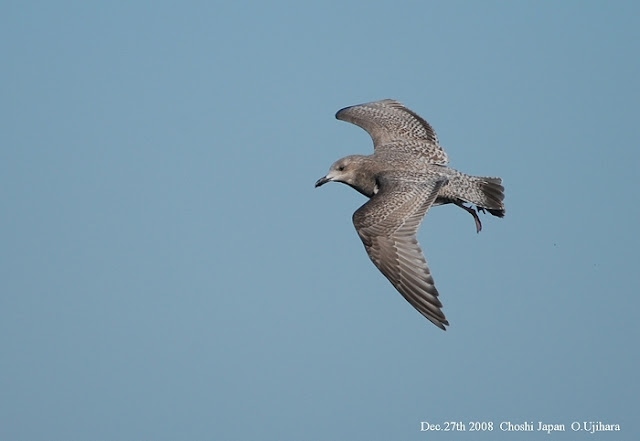


Please not how the head shape changes in several of the Thayer’s from Japan depending their posture and behaviour.
 |
| Thayer’s Gull: from top left to right bottom: 1: 4.2.2012, Hvide Sande Harbour, Denmark, Kent Olsen; 2-3: (same individual) 27.12.2008, Coshi, Japan, M. Ujihara; 4: 28.12.2008, Coshi, Japan, M. Ujihara; 5-6: (same individual) 8.12.2008, Coshi, Japan, M. Ujihara; 7: 4.2.2012, Hvide Sande Harbour, Denmark, Kent Olsen; and 8-9: (same individual) 28.12.2008, Coshi, Japan, M. Ujihara. |
I do not think the head of the Danish bird is neither that abnormally flat, nor its bill unusually big. Perhaps my assessment of shape is severely lacking, but I would not say that the head of the Danish bird looks neither flatter than any of these six Japanese examples, nor that its bill looks bigger. For anyone who wants to check, the five examples photographed by Masashi Shinjo in Choshi can be found in their proper context here, respectively: here, here, here, here and here.
 |
| Thayer’s Gull: upper row: 1-6: 4.2.2012, Hvide Sande Harbour, Denmark, Kent Olsen; lower row: 7-12: six different adult or subadult Thayer's Gulls from Japan, Peter Adriaens & Masashi Shinjo. |


Thursday, 26 April 2012
The Danish gull now versus a Thayer's from California
Peter Adriaens wrote me and said: “one of the Thayer's Gulls that I photographed in California is called into question - once more.
It is this bird
.
I hope that at least the photographer (me) is allowed to defend the identification of this bird? It amazes me that people approach identification of Thayer's Gull with extreme caution, yet need just one photograph to dismiss it as a hybrid - which is often even more difficult to identify than the real thing!
I have two more photos of this bird and Kent has put them together here. Note that the upper left photo was taken 2 seconds before the one in upper middle, and the upper right was taken when the bird had landed just 6 seconds after the one in the middle.
Also, I spent almost a full day at Bodega Bay then, together with Steve Howell. We discussed and photographed many of these Thayer's-like birds, and this one was not a problem.
My reasons for identifying this bird as Thayer's Gull as opposed to Glaucous-winged x American Herring Gull were (and still are):
- relatively small size
- thin, parallel-sided bill
- slimmer, more elongated body than other large gulls, with fairly long primary projection
- strong dark peppering on inner primaries (usually absent in GWGU and AHGU, but often seen in 'good' Thayer's Gulls); I have attached a crop of the outer wing so this can be more easily judged (lower left). Note also the obvious white tips to the primary coverts, though I am not sure if these are useful as a character.
- distinct but irregular barring on greater coverts (usually plainer pattern in GWGU and AHGU, especially in the former species)
- full juvenile plumage (in late January)
- frosty, almost whitish appearance of scapulars
To my eyes, nothing seems wrong for Thayer's Gull here, but I am eager to learn so I hope that people who feel that this is more likely a hybrid could somewhat explain their reasons? I suspect it was the apparent bill shape in this photo that seemed wrong, but as anyone who takes photographs of gulls will know, a bill often looks heavier than in reality when turned away from the camera. In addition, note that the bird holds its bill slightly open in flight, adding to the heavy impression in the photo.
Anyway, I hope this explains things a bit.
Best wishes
Peter”
It is this bird
 |
| Thayer’s Gull: from top left to right bottom: 1-4: (same individual) 28.1.2011, Bodega Bay, California, Peter Adriaens; 5-6: (same individual) 4.2.2012,
Hvide Sande Harbour, Denmark, Kent Olsen. Note that the upper left photo was taken 2 seconds before the one in upper middle, and the upper right was taken when the bird had landed just 6 seconds after the one in the middle. |
I hope that at least the photographer (me) is allowed to defend the identification of this bird? It amazes me that people approach identification of Thayer's Gull with extreme caution, yet need just one photograph to dismiss it as a hybrid - which is often even more difficult to identify than the real thing!
I have two more photos of this bird and Kent has put them together here. Note that the upper left photo was taken 2 seconds before the one in upper middle, and the upper right was taken when the bird had landed just 6 seconds after the one in the middle.
Also, I spent almost a full day at Bodega Bay then, together with Steve Howell. We discussed and photographed many of these Thayer's-like birds, and this one was not a problem.
My reasons for identifying this bird as Thayer's Gull as opposed to Glaucous-winged x American Herring Gull were (and still are):
- relatively small size
- thin, parallel-sided bill
- slimmer, more elongated body than other large gulls, with fairly long primary projection
- strong dark peppering on inner primaries (usually absent in GWGU and AHGU, but often seen in 'good' Thayer's Gulls); I have attached a crop of the outer wing so this can be more easily judged (lower left). Note also the obvious white tips to the primary coverts, though I am not sure if these are useful as a character.
- distinct but irregular barring on greater coverts (usually plainer pattern in GWGU and AHGU, especially in the former species)
- full juvenile plumage (in late January)
- frosty, almost whitish appearance of scapulars
To my eyes, nothing seems wrong for Thayer's Gull here, but I am eager to learn so I hope that people who feel that this is more likely a hybrid could somewhat explain their reasons? I suspect it was the apparent bill shape in this photo that seemed wrong, but as anyone who takes photographs of gulls will know, a bill often looks heavier than in reality when turned away from the camera. In addition, note that the bird holds its bill slightly open in flight, adding to the heavy impression in the photo.
Anyway, I hope this explains things a bit.
Best wishes
Peter”
Thursday, 19 April 2012
The Danish gull versus a Thayer's from Ontario in Canada
Few people keep arguing that something is wrong with the Danish bird without being able to specify what is actually wrong. Brandon Holden has some very nice gull photos here and he says in the GRO forum that there is something wrong with the appearance. I have taken the liberty to use some of his great photos of a Thayer’s from Ontario in Canada put up against the Danish bird for comparison.
.
People have criticised the head and bill shape. However, where comparing with these gulls Ontario, Ontario, Ontario, Ontario, Minesota, Nevada, Japan, Califonia, Califonia, Califonia, Califonia, Califonia, Lake Michigan, Newfoundland, British Colombia, Oregon, Japan, Japan og Norway I see so many similarities with the Danish gull here, here and here. Please note hove the head shape changes with behaviour, i.e. the flat forehead seen when it was feeding among Great Black-backed Gulls vanished when it landed on the nearby roof.
For additional comparison look at figure 6 in this paper on plumage development in captive Thayer’s chicks caught on Victoria Island in Arctic Canada. What a massive bill and flat forehead.
Kirk Zufelt has written two blog posts on size variation in Thayer's Gull part 1 and part 2 based on experiences from eastern Lake Superior in Ontario. He says that: ‘Thayer's Gull is thought of by many as a relatively finely structured gull with a rounder head and finer bill than the Herring. Indeed the females are usually structured in this fashion. This however is not a diagnostic field mark at all. The male Thayer's can be quite robust and to my eye are near indistinguishable from the Herring Gull by structure. In fact many male Thayer's are much more robust and "Herring Gull-like" in structure than the female Herrings. In the field I look closely at all the round headed petite look birds with most of them ending up being Herrings. The bottom line is the structure is a good way to narrow down the field but it is far from diagnostic’.
The pale eye ring has also been discussed, but again that character is also seen in other Thayer’s Gulls such as these from Lake Michigan, Califonia, California, Minesota, Ontario, Ireland, British Colombia and Ontario
I would be very interested if anybody could break down the Danish bird in a detailed analysis.
 |
| Thayer’s Gull: from top left to right bottom: 1) Denmark Kent Olsen; 2) Canada Brandon Holden; 3) Denmark Kent Olsen; 4) Canada Brandon Holden; 5) Denmark Kent Olsen; 6) Denmark Kent Olsen. |
 |
| Thayer’s Gull: from top left to right bottom: 1) Canada Brandon Holden; 2) Denmark Kent Olsen; 3) Denmark Kent Olsen. |
People have criticised the head and bill shape. However, where comparing with these gulls Ontario, Ontario, Ontario, Ontario, Minesota, Nevada, Japan, Califonia, Califonia, Califonia, Califonia, Califonia, Lake Michigan, Newfoundland, British Colombia, Oregon, Japan, Japan og Norway I see so many similarities with the Danish gull here, here and here. Please note hove the head shape changes with behaviour, i.e. the flat forehead seen when it was feeding among Great Black-backed Gulls vanished when it landed on the nearby roof.


For additional comparison look at figure 6 in this paper on plumage development in captive Thayer’s chicks caught on Victoria Island in Arctic Canada. What a massive bill and flat forehead.
Kirk Zufelt has written two blog posts on size variation in Thayer's Gull part 1 and part 2 based on experiences from eastern Lake Superior in Ontario. He says that: ‘Thayer's Gull is thought of by many as a relatively finely structured gull with a rounder head and finer bill than the Herring. Indeed the females are usually structured in this fashion. This however is not a diagnostic field mark at all. The male Thayer's can be quite robust and to my eye are near indistinguishable from the Herring Gull by structure. In fact many male Thayer's are much more robust and "Herring Gull-like" in structure than the female Herrings. In the field I look closely at all the round headed petite look birds with most of them ending up being Herrings. The bottom line is the structure is a good way to narrow down the field but it is far from diagnostic’.
The pale eye ring has also been discussed, but again that character is also seen in other Thayer’s Gulls such as these from Lake Michigan, Califonia, California, Minesota, Ontario, Ireland, British Colombia and Ontario


I would be very interested if anybody could break down the Danish bird in a detailed analysis.
Tuesday, 17 April 2012
Thayer's Gull with focus on primary projection
It seemed as if the Danish gull had been discussed in almost every possible detail, but now some people have once again returned to the hybrid speculations mainly due to the similarities between the Danish gull and the Nelson’s Gull in this and this photo posted on Larusology.
.
There are some similarities between that Nelson's Gull and the Danish bird. However, as Peter Adriaens says: ‘there are also some clear differences, not just in size and shape or bill pattern, but also in plumage.
There are subtle differences in the general colour of the plumage, pattern of tertials, shape of the lower scapulars, etc, but I think the most obvious differences are:
1) Bright pink bill, quite like Glaucous Gull (clearly duller in the Danish bird);
2) Short primary projection, again like Glaucous Gull. Note the difference in primary spacing in the composite with the Danish bird and that Nelson's Gull as an inset.
3) Primary pattern. In the Danish bird, P6-10 have dark outer webs, and P4-5 have distinct dark subterminal spots. In that Nelson's Gull, only P7-10 have dark outer webs, and only P5-6 have distinct dark subterminal spots. So I would say that this Nelson's Gull is only a superficial match for the Danish bird. When you study the details, the two are quite different”.


 |
Note the difference in primary spacing in the composite with the Danish bird and that Nelson's Gull insertet in the corner.
|
There are some similarities between that Nelson's Gull and the Danish bird. However, as Peter Adriaens says: ‘there are also some clear differences, not just in size and shape or bill pattern, but also in plumage.
There are subtle differences in the general colour of the plumage, pattern of tertials, shape of the lower scapulars, etc, but I think the most obvious differences are:
1) Bright pink bill, quite like Glaucous Gull (clearly duller in the Danish bird);
2) Short primary projection, again like Glaucous Gull. Note the difference in primary spacing in the composite with the Danish bird and that Nelson's Gull as an inset.
3) Primary pattern. In the Danish bird, P6-10 have dark outer webs, and P4-5 have distinct dark subterminal spots. In that Nelson's Gull, only P7-10 have dark outer webs, and only P5-6 have distinct dark subterminal spots. So I would say that this Nelson's Gull is only a superficial match for the Danish bird. When you study the details, the two are quite different”.
Wednesday, 11 April 2012
Thayer's Gull in close-ups that illustrate the finer details
It has been stated many times before, but I’ll do it again. When evaluating jizz one should always remember that single situation photos will not always do a bird justice. It is always best to make a judgement based on multiple photos capturing different posture/behaviour/situations if at all possible.

Several have stated that head profile in the Danish gull is very herring gull-like and head size is relatively large. Even though this is certainly not uncommon in male Thayer’s Gull it has provoked doubt and fuelled hybrid speculations among birders who live in hybrid hotspots such as the US West Coast where hybrids plumage-wise almost make a complete match with the wintering Thayer’s and where people are left with size, proportions and jizz to make a safe ID.
I have trouble understanding that even though so many experienced gull watchers have joined this discussion the main argue against the Danish gull being a Thayer’s is size and proportions of especially head and bill. I expect we all have experience with gulls changing appearance in relation to behaviour and posture.
For comparison I have posted two photos of an Iceland Gull feeding in the same place in the container just few minutes before. It was normal round headed when walking in safe distance; however, when it joined the feeding frenzy is suddenly transformed into a large-headed bird with flat forehead. It was striking how the appearance and jizz changed, especially the impression that the head suddenly appeared much larger relative to the body when the bird feed.
I’m not stating the Danish gull transformed into a small petit female, but the relative large headed appearance certainly changed. When watching the gull on the roof I actually had to view my camera display for finer details to make sure it was the same gull. I acknowledge that proportions and size strongly indicates that it is a male, but I believe that the scary appearance is also caused by an artefact created by posture and behaviour and possibly also the telephoto effect induced by my Canon 500 mm lens.

I might be wrong, and then please refresh my memory, but in my humble opinion there are no plumage characters which actually directly speak against Thayer’s. All plumage characters that people have found not supportive of Thayer’s have been matched in other Thayer's Gulls with safe ID.
People have e.g. argued that the outer tail feathers and the details in the venetian blind in the primaries is not pro Thayer’s. Therefore I have also collected wing and tail shot. I don’t see any difference in these characters compared with several examples of Thayer’s photographed away from the hybrid hotspots.
I completely acknowledge that people living in a hybrid hotspot use a very restricted view on what a true Thayer’s look like and due to scary hybrids feel that they are mostly left with size, proportions and jizz to make a safe ID. However, 'the swarm of hybrids on the American west coast is mostly a local problem, not a worldwide one' as stated by Peter Adriaens.

Thursday, 5 April 2012
Thayer's Gull in direct comparison with other Thayer's Gulls
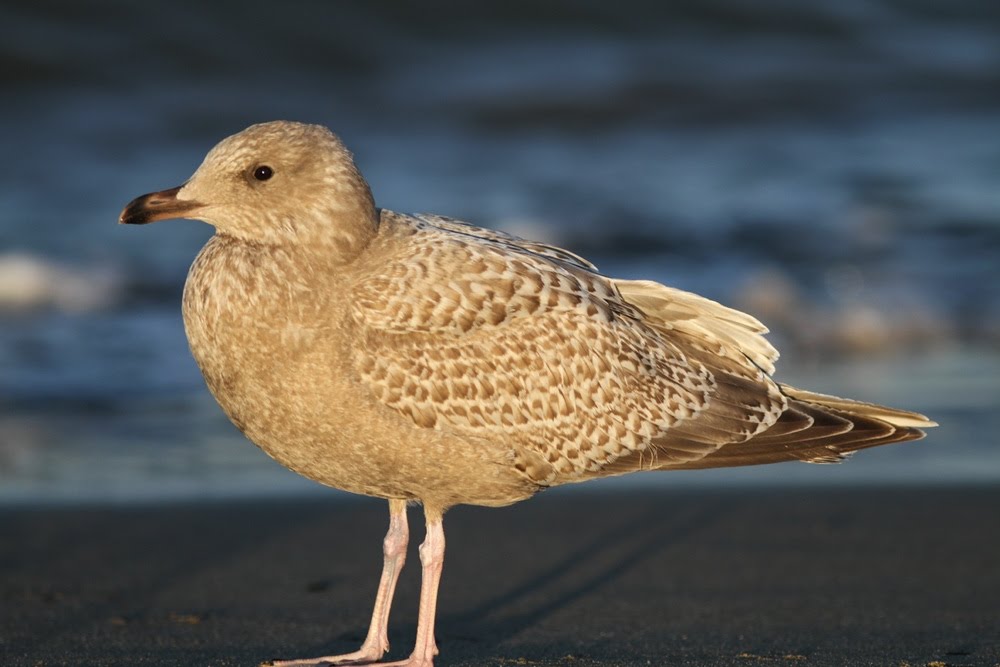
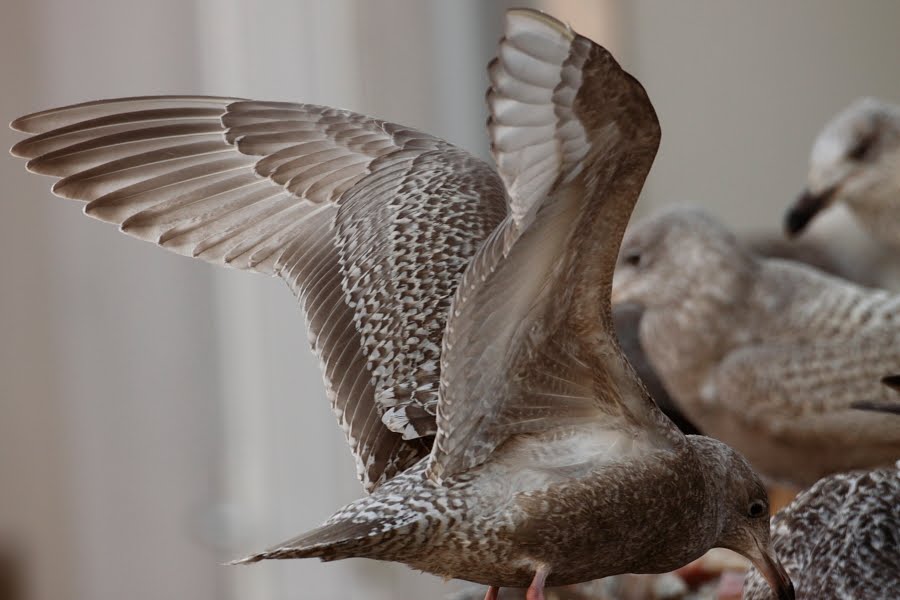
Here it’s possible to evaluate the Danish gull in direct comparison with Thayer’s Gull from California and Japan. All the photos used in the collages are also posted in larger versions below. Remember to click on the photos to see them in large versions.
 |
| Thayer’s Gull overall JIZZ: from top left to right bottom: 1) California 27.1.2011 Peter Adriaens; 2) California December Hans Larsson; 3) California December Hans Larsson; 4) California 27.1.2011 Peter Adriaens; 5) Denmark 4.2.2012 Kent Olsen; 6) California 27.1.2011 Peter Adriaens; 7) California 28.1.2011 Peter Adriaens; 8) Japan 13.3.2012 Peter Adriaens; 9) California 22.1.2011 Peter Adriaens. |
 |
| Thayer’s
Gull upperparts: from top
left to right bottom: 1) California 27.1.2011 Peter Adriaens; 2) California
December Hans Larsson; 3) California
27.1.2011 Peter Adriaens; 4)
California 27.1.2011 Peter
Adriaens; 5) Denmark 4.2.2012 Kent
Olsen; 6) California December Hans
Larsson; 7) California 22.1.2011 Peter
Adriaens; 8) Denmark 4.2.2012 Kent
Olsen; 9) California December Hans
Larsson. |
 |
| Thayer’s Gull underparts: from top left to right bottom: 1) California 27.1.2011 Peter Adriaens; 2) California 27.1.2011 Peter Adriaens; 3) California 1.2.2011 Peter Adriaens; 4) Denmark 4.2.2012 Kent Olsen; 5) Denmark 4.2.2012 Kent Olsen; 6) Denmark 4.2.2012 Kent Olsen; 7) California December Hans Larsson; 8) California 19.1.2011 Peter Adriaens; 9) California 25.1.2011 Peter Adriaens; 10) Japan 13.3.2012 Peter Adriaens; 11) California 27.1.2011 Peter Adriaens; 12) California December Hans Larsson. |
 |
| Thayer’s Gull underwing and axillaries: from top left to right bottom: 1) California 28.1.2011 Peter Adriaens; 2) Denmark 4.2.2012 Kent Olsen; 3) California December Hans Larsson; 4) California 27.1.2011 Peter Adriaens; 5) Denmark 4.2.2012 Kent Olsen;(large insert); 6) California 1.2.2011 Peter Adriaens; 7) California 27.1.2011 Peter Adriaens; 8) California 25.1.2011 Peter Adriaens; 9) California 27.1.2011 Peter Adriaens; 10) California 27.1.2011 Peter Adriaens; 11) California 19.1.2011 Peter Adriaens. |
 |
| Thayer’s Gull upperwing: from top left to right bottom: 1) California 27.1.2011 Peter Adriaens; 2) California 28.1.2011 Peter Adriaens; 3) California 25.1.2011 Peter Adriaens; 4) Denmark 4.2.2012 Kent Olsen; 5) Denmark 4.2.2012 Kent Olsen; 6) Denmark 4.2.2012 Kent Olsen; 7) California 27.1.2011 Peter Adriaens; 8) California 19.1.2011 Peter Adriaens; 9) California 27.1.2011 Peter Adriaens; 10) California December Hans Larsson; 11) California December Hans Larsson; 12) California December Hans Larsson. |
 |
| Thayer’s Gull overall macro view: all photos: Denmark 4.2.2012 Kent Olsen. |
 |
| Point Reyes, California 27.1.2011 Peter Adriaens |
 |
| California December Hans Larsson |
 |
| California December Hans Larsson |
 |
| Point Reyes, California 27.1.2011 Peter Adriaens |
 |
| Hvide Sande Harbour, Denmark 4.2.2012 Kent Olsen |
 |
| Point Reyes, California 27.1.2011 Peter Adriaens |
 |
| Bodega Bay, California 28.1.2011 Peter Adriaens |
 |
| Choshi, Japan 13.3.2012 Peter Adriaens |
 |
| Pillar Point, California 22.1.2011 Peter Adriaens |
 |
| Pillar Point, California 22.1.2011 Peter Adriaens |
 |
| California December Hans Larsson |
 |
| California December Hans Larsson |
 |
| California December Hans Larsson |
 |
| Hvide Sande Harbour, Denmark 4.2.2012 Kent Olsen |
 |
| Bodega Bay, California 27.1.2011 Peter Adriaens |
 |
| Bodega Bay, California 27.1.2011 Peter Adriaens |
 |
| Half Moon Bay, California 19.1.2011 Peter Adriaens |
 |
| Monterey, California 1.2.2011 Peter Adriaens |
 |
| Petaluma, California 25.1.2011 Peter Adriaens |
 |
| Hvide Sande Harbour, Denmark 4.2.2012 Kent Olsen |
 |
| Hvide Sande Harbour, Denmark 4.2.2012 Kent Olsen |
 |
| Bodega Bay, California 27.1.2011 Peter Adriaens |
 |
| Bodega Bay, California 27.1.2011 Peter Adriaens |
 |
| Bodega Bay, California 28.1.2011 Peter Adriaens |
 |
| California December Hans Larsson |
 |
| California December Hans Larsson |
 |
| Bodega Bay, California 27.1.2011 Peter Adriaens |
 |
| Bodega Bay, California 27.1.2011 Peter Adriaens |
 |
| Hvide Sande Harbour, Denmark 4.2.2012 Kent Olsen |
 |
| Hvide Sande Harbour, Denmark 4.2.2012 Kent Olsen |
 |
| Hvide Sande Harbour, Denmark 4.2.2012 Kent Olsen |
 |
| Hvide Sande Harbour, Denmark 4.2.2012 Kent Olsen |
 |
| Hvide Sande Harbour, Denmark 4.2.2012 Kent Olsen |
 |
| Hvide Sande Harbour, Denmark 4.2.2012 Kent Olsen |
 |
| Hvide Sande Harbour, Denmark 4.2.2012 Kent Olsen |
 |
| Hvide Sande Harbour, Denmark 4.2.2012 Kent Olsen |
 |
| Hvide Sande Harbour, Denmark 4.2.2012 Kent Olsen |
 |
| Monterey Bay, California 1.2.2011 Peter Adriaens |
 |
| Half Moon Bay, California 19.1.2011 Peter Adriaens |
Subscribe to:
Posts (Atom)