Showing posts with label Larus cachinnans x Larus argentatus. Show all posts

Monday, 15 September 2014

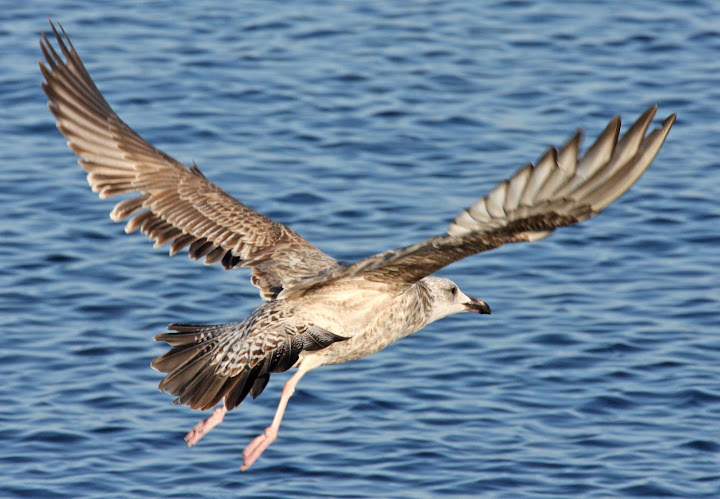
Caspian Gull (Larus cachinnans), 4cy, 14.9.2014, Grenaa Harbour

This could be a pure cachinnans and even though one may argue that most of the features seen in this bird also fit argentatus, there are firm clues that at least one of the parents must have been a cachinnans. Even though the upperparts are rather pale; iris rather pale; head relatively striated; and the black band on P5 rather narrow, it would not surprise me if it still fits within the phenotypic variation found in true cachinnans. However, a hybrid or backcross is not easy to rule out.

The winter streaks in head are needle-thin and very distinctive without the typical coarse spotted argentatus appearance; cachinnans can have such streaks in autumn as also seen on Netfugl.

Characters in favor of cachinnans are e.g. the relative and thin long legs compared to the adjacent Herring Gulls, a bill which is relative slim without pronounced gonys angle, a dark red orbital ring, reminiscence of a cachinnans neck boa with dark spots on lower neck, and upperparts which are marginally darker than on nearby argentatus.


Wednesday, 6 February 2013

Possible Caspian Gull x Herring Gull hybrid


This could be a pure cachinnans and even though one may argue that most of the features seen in this bird also fit argentatus, there are firm clues that at least one of the parents must have been a cachinnans. Even though the upperparts are rather pale; head relatively large and striated; and p10 lack white mirror, it would not surprise me if it still fits within the phenotypic variation found in true cachinnans. However, a hybrid or backcross is not easy to rule out and on current knowledge this may even seem like the most probable solution. See other comments on Gull Research.

Photoes were taken on February 2, 2013 at Vejers Strand in West Jutland.


Monday, 12 December 2011

Possible Caspian Gull x Herring Gull hybrid

This gull was photographed on November 28, 2011 and it is the fifth winter it returns to Aarhus Harbour. It has a lot of Caspian Gull to it. However, the ID adds a little uncomfortable feeling as the gull possesses some argentatus-jizz. Even though none of the features that it shows are as itself exclusive of either one of the species most features seem to support cachinnans as best illustrated in the photos from its previous stay in 2010. A hybrid cachinnans x argentatus might be the best explanation?

Each year it is has had the almost complete white summer head from November shortly after arriving at the site. In October 2007 it was seen standing with argentatus, in November 2007 it was also seen standing with argentatus and in December 2007 it was seen with open wing here and here and standing with argentatus. In November 2009 it was seen in flight, standing with argentatus, swimming and standing with argentatus, swimming with argentatus and standing alone.


Saturday, 1 January 2011

Possible Caspian Gull x Herring Gull hybrid

This 1st winter gull was seen at Odense Kanal north of Odense on December 30, 2010. All photos were taken by local birder and finder Tim Hesselballe Hansen.

There certainly is some cachinnans in it but many things point to at least f1 or f2 parentage of argentatus especially as the dark markings on uppertail coverts are very coarse as in argentatus. The tail band has a lot of thin additional transversal bands towards the base of rectrices which is a kind of a cachinnans "trademark" but the extensiveness in this individual is together with the heavily patterned uppertail coverts and rump much darker than the average cachinnans so, even if we don't really know it things point to a possible hybrid.

Other individuals with quite similar uppertail here, here and here.


Saturday, 4 December 2010

Possible Caspian Gull x Herring Gull hybrid

In most features this gull from Aarhus East Harbour seen on December 2-3, 2010, looks a lot like a pure Caspian Gull even though such an ID adds a little uncomfortable feeling as the gull possesses slight fore-head streaking and streaking on top of its head together with some argentatus-jizz. Even though none of the features that it shows are as itself exclusive of either one of the species most features seem to support cachinnans. It might be safe to say that it is probably a cachinnans but with certain off-typical features.

It is the fourth winter that we see this gull and each year it is has had the almost complete white summer head from November shortly after arriving at the site. In October 2007 it was seen standing with argentatus, in November 2007 it was also seen standing with argentatus and in December 2007 it was seen with open wing here and here and standing with argentatus. In November 2009 it was seen in flight, standing with argentatus, swimming and standing with argentatus, swimming with argentatus and standing alone.

The bare part colour in the opened bill is spot on for cachinnans being orangey-yellow at the base of the mandibles where the skin colour in michahellis is typical blood red and light pink in argentatus.

P5 in the right wing has black only on the outer edge whereas the same feather in the other wing has a narrow though complete black band. Additionally there is little black spot on p4 in both wings, extensive grey tongues on the outer primaries, all white tips on p10, small white mirror on p9.


It has a good cachinnans-jizz with high push up breast, flat belly slightly dropped behind legs. Additionally the upperparts are slightly darker than on nearby argentatus.

Once in a while it gains some argentatus appearance due to e.g. body structure and head/bill profile. The short bill has a rather blunt tip which could fit a cachinnans, but is more argentatus-like. 

The eye color is relative dark with a slight green peppering in the iris and when seen at some distance it stood out as being darker than in argentatus. There is a thin red orbital ring seen at close range where argentatus normally has a yellowish ring.


The bill is rather short and blunt at the tip; could fit a cachinnans, but is more argentatus-like. 

When feeding on ground or seen on water it mostly gives a cachinnans-jizz with rather small head, slender elongated rear and flat back, high pushed up breast.

The distinctive black feather shafts on the outer primaries in the upperwing are commonly seen in adult cachinnans. 

Once in a while it gains some argentatus appearance due to e.g. body structure and head/bill profile.

In the stretched wing the grey tongues on the outer primaries are obvious when seen from underneath and the black on primaries creates a classic cachinnans boomerang.

P5 in the right wing has black only on the outer edge whereas same feather the left wing has a narrow though complete black band. Additionally there is little black spot on p4 in both wings, extensive grey tongues on the outer primaries, all white tips on p10, small white mirror on p9.


In the stretched wing the grey tongues on the outer primaries are obvious when seen from underneath and the black on primaries creates a classic cachinnans boomerang.


Sunday, 13 January 2008

Possible Caspian Gull x Herring Gull hybrid

This gull was seen on Aarhus East Harbor on October 30, 2007. When seen at distance it appeared long-legged with a rather dark eye in a generally white head, slender bill and saturated dark upperparts all resulting in a cachinnans impression but with a few drawbacks.

The thin winter streaks in head are needle-thin and very distinctive without the typical coarse spotted argentatus appearance; cachinnans can have such streaks in October as also seen on Netfugl but often less developed than in this gull. It appears not to be a pure Caspian Gull as you expect a good cachinnans to look like.

Characters in favor of cachinnans are the relative long legs compared to the adjacent Herring Gulls, the colourless bill is relative slim without pronounced gonys angle, the red spot on gonys appears to just reach lower edge of upper mandible, on the yawning gull the bare part colour in the opened bill appears to be orangey-yellow at the very most base of the mandibles where the colour is typical blood red in michahellis and light pink in pure argentatus, the eye has red orbital ring and is relative dark, there are reminiscence of a cachinnans neck boa with dark spots on lower neck, the upperparts are darker than on nearby argentatus. But as mentioned there are also characters not in favor of cachinnans such as the bill is not really long and not really pointed at its tip (upper mandible curves strongly as seen in the yawning photo) and on jizz it has a certain Herring Gull feel about it

In Poland it has for years been documented that Caspian Gull are moving in to the Herring Gull colonies giving mixed pairs producing offspring. Such a bird with an intermediary plumage detail could originate from a mixed colony, but we won't know that unless it is ringed. A hybrid can look like one of the parents or it can look intermediate and a pure bird can also look "intermediate" therefore an opened wing to see its p10 pattern is to wish for.